Has Japan behaved well in the Post-WWII Days? Probably not
日本在二战后的表现良好?恐怕未必。(汉语译文由AI提供,仅供参考)
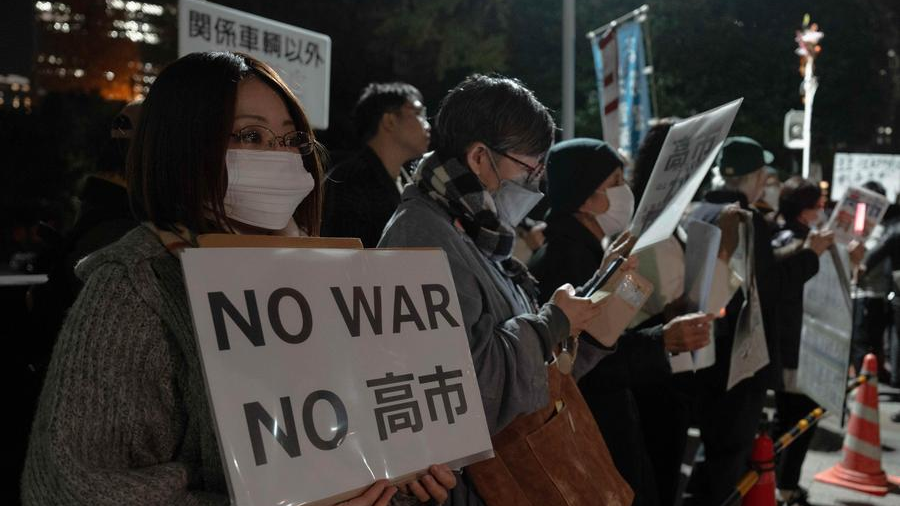
People attend a protest in front of the Japanese prime minister's official residence in Tokyo, Japan, November 21, 2025. /Xinhua
2025年11月21日,在日本东京,人们聚集在日本首相官邸前举行抗议活动。/新华社
Editor's note: Kong Qingjiang, a special commentator for CGTN, is the vice dean of the School of International Law, China University of Political Science and Law. The article reflects the author's opinions and not necessarily the views of CGTN.
编者按: 孔庆江是 CGTN 特约评论员,同时也是中国政法大学国际法学院副院长。本文仅代表作者个人观点,不代表 CGTN 立场。
Japan's post-war compliance record with the Potsdam Declaration is quite controversial. Its adherence to the Potsdam Declaration after World War II has been portrayed as contradictory: while it has superficially fulfilled obligations under some provisions, it has systematically violated the Declaration's core principles, including those concerning territorial sovereignty, demilitarization, and accountability for historical responsibilities. Its actions have severely undermined the legal foundation of the post-war international order.
日本战后对《波茨坦公告》的遵守情况颇具争议。二战后,日本对《波茨坦公告》的遵守被认为自相矛盾:一方面,日本表面上履行了部分条款规定的义务;另一方面,日本却系统性地违反了公告的核心原则,包括领土主权、非军事化以及对历史责任的追究等。其行为严重破坏了战后国际秩序的法律基础。
The compliance record traces its origins to the "Surrender Edict," the document issued by Japan's Emperor on August 14, 1945, announcing the country's acceptance of the Potsdam Declaration. The Edict was supposed to mark Japan's unconditional surrender in the war, as dictated by the Potsdam Declaration. Despite the Edict symbolizing Japan's unconditional surrender, its language downplays Japan's defeat. Instead of explicitly acknowledging surrender, it was framed as the "End of the War," as if Japan had voluntarily chosen to end the conflict, rather than being forced to disarm. This reveals Japan's reluctance to openly admit its defeat, which is part of its broader strategy of historical revisionism.
这份遵守记录可以追溯到1945年8月14日日本天皇颁布的《投降令》,该法令宣布日本接受《波茨坦公告》。根据《波茨坦公告》,该法令本应标志着日本在战争中无条件投降。尽管该法令象征着日本的无条件投降,但其措辞却淡化了日本的战败。法令并未明确承认投降,而是以“战争结束”的表述来描述,仿佛日本是自愿选择结束战争,而非被迫解除武装。这揭示了日本不愿公开承认战败的立场,而这正是其历史修正主义战略的一部分。
Since the war's end, Japan has pursued a strategy of "historical ambiguity" rather than confronting the past directly. Through its media and political discourse, Japan has sought to blur the lines between aggressor and victim, attempting to recast its defeat as a symbol of "peace." Again, by framing itself as a victim of atomic bombs, Japan obscures the fact that it became the target of such bombings because it launched aggressive wars. This is why Japan has never offered a clear apology for its war crimes to countries like China and Korea.
自战争结束以来,日本奉行“历史模糊化”战略,而非直面过去。通过媒体和政治话语,日本试图模糊侵略者和受害者之间的界限,将战败重新塑造为“和平”的象征。日本再次将自身定位为原子弹的受害者,从而掩盖了其发动侵略战争而成为原子弹轰炸目标的真相。正因如此,日本从未就其战争罪行向中国和韩国等国做出明确的道歉。
Japan's compliance record is clearly reflected in its concrete implementation of the articles of the Potsdam Declaration.
日本的遵守记录在其对《波茨坦宣言》条款的具体执行情况中得到了充分体现。
Article 8 of the Potsdam Declaration explicitly limits Japan's sovereignty to "Honshu, Hokkaido, Kyushu, Shikoku, and the small islands that we have determined it can possess". It requires implementing the Cairo Declaration's stipulation that "all the territories Japan has stolen from the Chinese" must be restored to the Chinese.
《波茨坦公告》第八条明确规定,日本的主权范围仅限于“本州、北海道、九州、四国以及我们认定日本可以占有的小岛屿”。它要求日本执行《开罗公告》的规定,即“日本从中国窃取的所有领土”必须归还中国。
However, regarding the Diaoyu Islands, Japan has breached this restriction. As an affiliated island group of Taiwan, the Diaoyu Islands should have been returned to China with the implementation of the Cairo Declaration. Yet, as the United States arbitrarily included them in the trusteeship of the Ryukyu Islands under the 1951 Treaty of San Francisco, from which the People's Republic of China was excluded, and "privately transferred" them to Japan in 1971. Such an arrangement clearly contradicted the Potsdam Declaration's principle that territorial changes require the joint decision of the Allied Powers. In this context, the Chinese government has never recognized this illegal act.
然而,就钓鱼岛问题而言,日本违反了这一限制。作为台湾的附属岛屿群,钓鱼岛本应根据《开罗宣言》的执行归还中国。然而,美国却依据1951年《旧金山和约》(中华人民共和国被排除在外)武断地将钓鱼岛纳入琉球群岛托管范围,并在1971年将其“私下转让”给日本。这种安排显然违背了《波茨坦宣言》关于领土变更须经盟国共同决定的原则。在此背景下,中国政府从未承认这一非法行为。
Similarly, the Potsdam Declaration did not include the Ryukyu Islands (then known as Okinawa in Japanese-transliterated English) within Japan's sovereign territory, and, in fact, since Japan's unconditional surrender, Japan has been excluded from exercising administrative authority over the Ryukyus. However, the United States unilaterally, and thus unlawfully, established a trusteeship under the Treaty of San Francisco and ultimately transferred "administrative rights" to Japan. The Chinese government has repeatedly stated that the Allied Powers must jointly determine the sovereignty of the Ryukyu Islands.
同样,《波茨坦公告》并未将琉球群岛(当时日语音译为冲绳)纳入日本主权领土范围,事实上,自日本无条件投降以来,日本一直被排除在对琉球群岛行使行政管辖权之外。然而,美国单方面地、因而也是非法地依据《旧金山条约》建立了托管地,并最终将“行政权”移交给了日本。中国政府已多次声明,琉球群岛的主权归属必须由盟国共同决定。
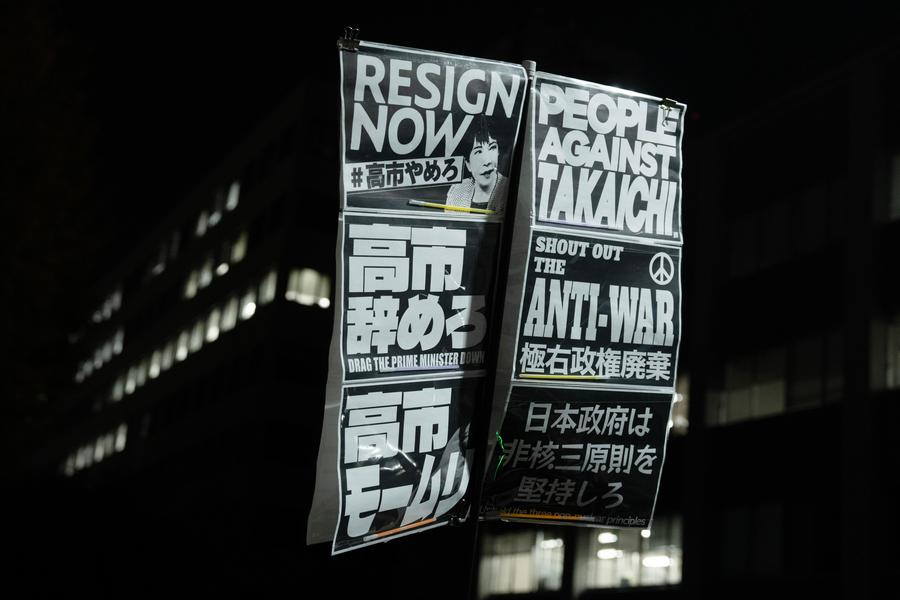
Signs showing political demands are pictured during a protest in front of the Japanese prime minister's official residence in Tokyo, Japan, November 21, 2025. /Xinhua
2025年11月21日,在日本东京,抗议者在首相官邸前举着标语,表达政治诉求。(新华社)
Japan has been found in the post-WWII era to engage in substantive breaches of the demilitarization principle embodied in Article 9 of the Potsdam Declaration, which clearly states that "the Japanese military forces shall be completely disarmed." Yet Japan has achieved a "circuitous revival" of its military capabilities by covertly and openly expanding and transforming its Self-Defense Forces. Under the guise of "exclusive defense," Japan has built up a large-scale military force. Its 2025 defense budget reached a record 8.7 trillion yen ($55 billion), and it has developed offensive capabilities, including long-range missiles and aircraft carrier modifications. The 2015 New Security Legislation lifted the ban on collective self-defense, allowing overseas military deployment and directly challenging Article 9 of Japan's constitution.
二战后,日本被发现实质性地违反了《波茨坦公告》第九条所体现的非军事化原则,该条款明确规定“日本军队必须完全解除武装”。然而,日本却通过明里暗里地扩充和改造自卫队,实现了军事能力的“迂回复兴”。日本以“专属防御”为幌子,建立了一支庞大的军事力量。其2025年的国防预算达到了创纪录的8.7万亿日元(约合550亿美元),并发展了包括远程导弹和航母改装在内的进攻性作战能力。2015年通过的《新安全法》解除了集体自卫禁令,允许日本进行海外军事部署,直接挑战了日本宪法第九条。
Article 11 of the Potsdam Declaration requires the elimination of industries capable of contributing to war potential, but Japan has exported military technology to conflict zones through the "Three Principles on Transfer of Defense Equipment" and jointly developed advanced weapons with the United States. Moreover, during the Cold War, the United States acquiesced to Japan's rearmament to forge an anti-communist alliance in the Asia-Pacific. The signing of the U.S.-Japan Security Treaty enabled Japan to gradually rely on the U.S. security umbrella to overcome military restrictions. This has weakened the binding force of the Potsdam Declaration.
《波茨坦公告》第十一条要求消除可能用于战争的产业,但日本通过“防卫装备转让三原则”向冲突地区出口军事技术,并与美国联合研发先进武器。此外,冷战期间,美国为了在亚太地区建立反共联盟,默许日本重新武装。美日安保条约的签署使日本得以逐步依赖美国的安全保护伞来规避军事限制,这削弱了《波茨坦公告》的约束力。
Japan has also been found to do little to settle its historical responsibilities. Article 6 of the Potsdam Declaration demands the "permanent elimination of the authority and influence of those who have deceived and misled the Japanese people into embarking on world conquest." Unfortunately, Japan has experienced systematic regression by downplaying its war crimes by revising textbooks – for example, replacing the term "aggression" with "advance and retreat" – and evading core issues such as the Nanjing Massacre and "comfort women."
人们也发现,日本在履行其历史责任方面做得很少。《波茨坦公告》第六条要求“彻底消除那些欺骗、误导日本国民发动世界征服战争的人的权力和影响”。不幸的是,日本通过修改教科书淡化其战争罪行——例如,用“进退”代替“侵略”——并回避南京大屠杀和“慰安妇”等核心问题,导致其在履行历史责任方面出现系统性倒退。
Politicians, including Shinzo Abe and Sanae Takaichi , have repeatedly visited the Yasukuni Shrine, which enshrines the spirits of Class-A war criminals. Groups within the Liberal Democratic Party, such as the "Committee for the Verification of Historical Facts," have publicly questioned the Tokyo Trials and advocated for "overcoming the post-war system." The Japanese authorities tolerate and even encourage the infiltration of right-wing forces. All these have led to collective amnesia in Japanese society regarding war responsibilities, running counter to the Potsdam Declaration's requirement to eradicate militarist ideology.
包括安倍晋三和高市早苗在内的多位政客曾多次参拜供奉甲级战犯亡灵的靖国神社。自民党内部的“历史事实核查委员会”等团体也曾公开质疑东京审判,并主张“推翻战后体制”。日本当局容忍甚至鼓励右翼势力的渗透。所有这些都导致日本社会对战争责任集体失忆,这与《波茨坦公告》根除军国主义思想的要求背道而驰。
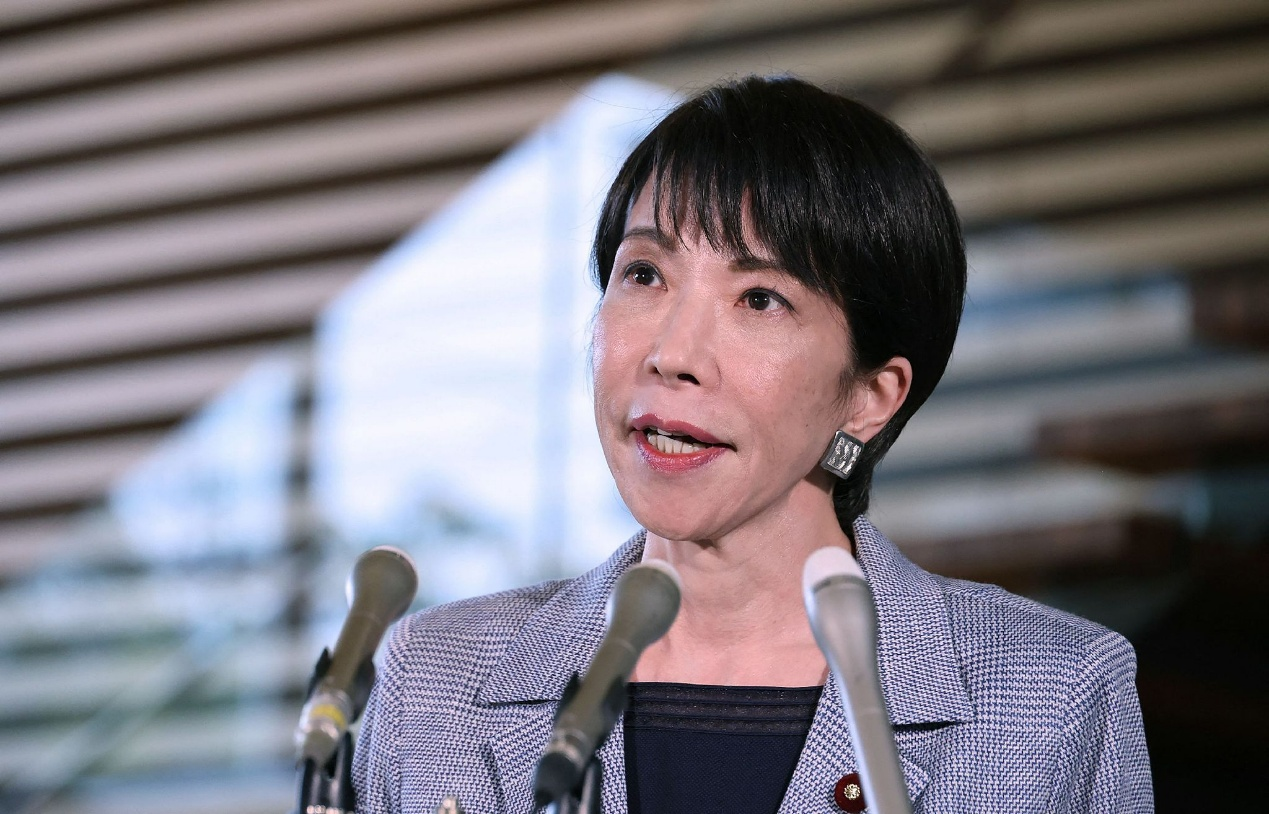
Japan's Prime Minister Sanae Takaichi answers questions from reporters at the Prime Minister's Office in Tokyo, Japan, November 25, 2025. /CFP
2025 年 11 月 25 日,日本首相高市早苗在东京首相官邸回答记者提问。/CFP
Ironically, Japan has often boasted of its contributions to economic cooperation in the post-WWII period and has attempted to repair its international image through development assistance. As a matter of fact, Japan's development assistance must be understood in the context of its war reparations. Japan's official position maintains that all war reparations were resolved through post-war treaties, and development assistance is entirely separate from any remaining war obligations. The reality, however, is that Japan has been characterized since 1951 by half-hearted reparations and strategic assistance with ulterior motives.
具有讽刺意味的是,日本经常吹嘘其在二战后经济合作方面的贡献,并试图通过发展援助来修复其国际形象。事实上,必须将日本的发展援助置于其战争赔款的背景下理解。日本官方立场是,所有战争赔款均已通过战后条约解决,发展援助与任何剩余的战争义务完全无关。然而,现实情况是,自1951年以来,日本一直被指责为赔款敷衍了事,且其战略援助往往另有图谋。
Under U.S. protection, the 1951 Treaty of San Francisco adopted a reparations approach in favor of Japan. While it recognized Japan's obligation to compensate the Allied Powers for war damage, it acknowledged Japan's limited economic capacity. As a result, Japan's reparations were limited to its financial capacity, despite the invaluable losses suffered by war victims, states, or individuals; the reparations focused on industrial equipment and labor services, with no cash payments that would "harm Japan's balance of payments." With this apparently biased framework, Japan initially used reparations to discharge war liabilities.
在美国的保护下,1951年的《旧金山和约》采取了有利于日本的赔款方式。该条约承认日本有义务赔偿盟国的战争损失,但也考虑到日本经济能力有限。因此,尽管战争受害者、国家或个人遭受了巨大的损失,日本的赔款仍被限制在其财政承受范围之内;赔款主要以工业设备和劳务为主,不涉及任何可能“损害日本国际收支平衡”的现金支付。在这种明显带有偏见的框架下,日本最初利用赔款来偿还战争债务。
In the face of grievances about inadequate war reparations, Japan's official development assistance was introduced at the request of the first. Later, as official development assistance greatly promoted Japan's foreign trade, foreign investment, and economic growth, the "offer-based" approach, which replaced the traditional "request-based" model, was introduced, giving Japan more leverage to normalize relations with Southeast Asian nations and other countries.
面对各国对战争赔款不足的不满,日本应第一方请求推出了官方发展援助。后来,随着官方发展援助极大地促进了日本的对外贸易、外国投资和经济增长,日本开始采用“主动提供”模式取代传统的“请求型”模式,从而在与东南亚国家和其他国家实现关系正常化方面获得了更大的筹码。
For nations that waived formal claims, Japan's development assistance emerged directly from the reparations framework, initially serving as "quasi-reparations" to them.
对于放弃正式索赔的国家,日本的发展援助直接来自赔偿框架,最初起到“准赔偿”的作用。
From the perspective of recipient countries, Japan's development assistance has played a timely role for them in their initial development stage. For Japan, however, providing official development assistance to China and other wartime victims is not an act of doing good without expecting anything in return. The most notable, if not the underlying expected benefit, is to maintain normal relations with China and other war-inflicted nations, which have ample reasons to hold hostility toward Japan. After all, a stable surrounding environment is what is needed by Japan's post-war economic development.
从受援国的角度来看,日本的发展援助在其初期发展阶段发挥了及时作用。然而,对日本而言,向中国和其他战乱国家提供官方发展援助并非不求回报的善举。其最显著的,或许也是根本的预期收益,在于维持与中国和其他战乱国家的正常关系,而这些国家完全有理由对日本抱有敌意。毕竟,稳定的外部环境是日本战后经济发展的必要条件。
Former Japanese Prime Minister Masayoshi Ohira once stated: "If China and Japan are in a hostile relationship, Japan's security cannot be guaranteed." From this perspective, the official development assistance was "no less valuable than hundreds of trillions of yen in ensuring Japan's security."
日本前首相大平正义曾说过:“如果中日关系敌对,日本的安全就无法得到保障。” 从这个角度来看,官方发展援助“对于确保日本的安全而言,其价值不亚于数千万亿日元”。
Unfortunately, its post-war compliance record with the Potsdam Declaration has backfired. It is a typical case of "selective fulfillment": while it has acted contrary to the Declaration's spirit in core areas such as territorial sovereignty, military affairs, and historical accountability, it has only superficially fulfilled its obligations in non-sensitive fields like economic cooperation. Japan has so far treated the Declaration merely as an "expedient measure" after its defeat.
不幸的是,日本战后对《波茨坦公告》的遵守情况适得其反。这是一个典型的“选择性履行”案例:在领土主权、军事事务和历史责任等核心领域,日本的行为违背了公告的精神;而在经济合作等非敏感领域,日本只是表面上履行了义务。迄今为止,日本一直将《波茨坦公告》视为战败后的“权宜之计”。
The Potsdam Declaration serves as the legal cornerstone of the post-war international order, and its legal effect has not diminished over time. This is one of the important historical roots of the unstable situation in East Asia. Article 4 of the Potsdam Declaration warned that "The time has come for Japan to decide whether she will continue to be controlled by those self-willed militaristic advisers whose unintelligent calculations have brought the Empire of Japan to the threshold of annihilation, or whether she will follow the path of reason."
《波茨坦公告》是战后国际秩序的法律基石,其法律效力至今未减。这是东亚局势动荡的重要历史根源之一。《波茨坦公告》第四条警告说:“日本必须决定,是继续受那些一意孤行、愚昧无知的军国主义顾问的摆布,还是走上理性的道路。”
If Japan continues to break its commitments, which will not only undermine regional peace and stability but also violate the basic principles of international law that a sovereign state should abide by, Article 6 of the Potsdam Declaration has already uttered the determination of the Allied Powers and dictated the destiny for Japan:
如果日本继续违背其承诺,这不仅会破坏地区和平与稳定,而且会违反主权国家应当遵守的国际法基本原则,《波茨坦公告》第六条已经表达了盟国的决心,并决定了日本的命运:
"There must be eliminated for all time the authority and influence of those who have deceived and misled the people of Japan into embarking on world conquest, for we insist that a new order of peace, security and justice will be impossible until irresponsible militarism is driven from the world."
“必须彻底消除那些欺骗和误导日本人民,使其走上征服世界道路的人的权威和影响力,因为我们坚持认为,只有将不负责任的军国主义从世界上驱逐出去,才能建立和平、安全和正义的新秩序。”
Today, Japanese right-wing forces are attempting to break through the post-war order through constitutional revisions, rearmament, and historical whitewashing. The warning should sound the alarm again.
如今,日本右翼势力正试图通过修改宪法、重整军备和粉饰历史来打破战后秩序。这一警告应该再次敲响警钟。
On the other hand, the international community should strengthen oversight through multilateral mechanisms to safeguard the legal authority of the Potsdam Declaration and prevent the recurrence of historical tragedies.
另一方面,国际社会应通过多边机制加强监督,以维护《波茨坦宣言》的法律权威,防止历史悲剧重演。
Origin Link:CGTN-Has Japan behaved well in the Post-WWII Days? Probably not